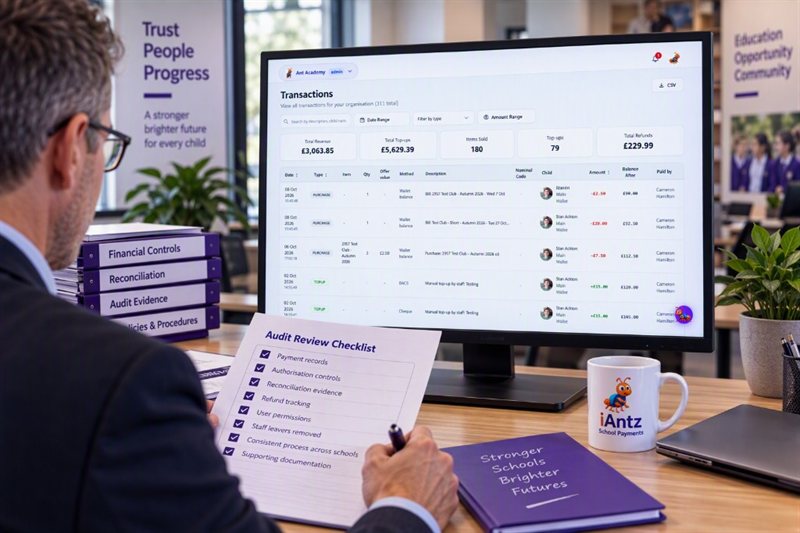
Ask yourself
- Can you trust your payment records?
- Are your financial controls clear?
- Does reconciliation stand up to scrutiny?
- Are all schools following the same approach?
This simple checklist highlights some of the key areas auditors typically review when assessing school income processes and the controls surrounding a school payment system. It is intended as general guidance only, and your auditors will advise on the specific requirements for your trust.
Can You Trust Your Payment Records?
For every payment received, you should be able to identify who paid, how much was paid, when it was paid, and what it was for.
The challenge is that schools often need to offer parents multiple ways to pay. Online payments, card payments, cash, cheques and even ad-hoc fundraising collections can all form part of the picture. While flexibility can improve accessibility for families, it can also create additional work when it comes to reporting and audit trails.
The more places income is recorded, the harder it becomes to demonstrate a complete picture of school income.
Ask yourself:
- Is there one consistent record of every payment across every school?
- Can you trace a payment from the parent, to the bank, to the finance ledger?
- Are all payment methods recorded in a consistent way?
- Can you quickly explain income collected through cash, cheques or fundraising events?
Are Your Financial Controls Clear and Well Documented?
Auditors want to see that financial controls exist and are consistently followed.
This goes beyond simply recording payments. Schools often support families through discounts, subsidies and hardship arrangements. These are entirely legitimate, but there should be a clear audit trail explaining why a reduced charge was applied and how it was funded.
Similarly, refunds should be traceable, particularly where full or partial refunds have been issued.
Ask yourself:
- Who can create a payment item and who approves it?
- Who can issue refunds, and are reasons recorded?
- Are partial refunds recorded with a reason and approval trail?
- Who can amend prices or balances after a transaction has taken place?
- Are discounts clearly linked to a funding source such as Pupil Premium, hardship funding or a grant?
- Can you demonstrate why a family paid less than the advertised amount?
- Are staff leavers removed promptly from systems?
Does Your Reconciliation Process Stand Up to Scrutiny?
Reconciliation is where issues often become visible.
Auditors will want to understand how income collected matches income received and how any differences are identified and resolved.
Ask yourself:
- How often do you reconcile income?
- How long does the process take?
- Can every discrepancy be explained quickly?
- Is the reconciliation process consistent across all schools?
- Is responsibility for reconciliation clearly defined?
Are All Schools Following the Same Approach?
Although schools may operate independently day to day, the trust is reviewed as a single organisation.
Different processes, reporting methods or systems between schools can create additional audit questions and increase workload for finance teams. Consistency makes reviews easier, reporting clearer and evidence simpler to gather.
Ask yourself:
- Are income processes consistent across all schools?
- Is evidence gathered in the same way across the trust?
- Does every school follow the same approval processes?
- Could any school produce the same information if requested tomorrow?
How Well Is Offline Income Managed?
Most schools are working towards becoming as cashless as possible, and for good reason. Digital payments provide stronger audit trails, reduce administration and simplify reconciliation.
However, schools also need to be inclusive. There will always be situations where cash payments are accepted, whether that's to support a family without access to online payments or to accommodate events such as non-uniform days, charity fundraising and community activities.
For auditors, the key question is not whether cash exists, but how it is controlled and recorded.
Ask yourself:
- How are cash and cheque payments logged?
- Who is responsible for handling and banking them?
- Are fundraising collections recorded and reconciled?
- Could any part of the process rely on manual records or spreadsheets?
- Is there a clear audit trail from collection to banking?
How Technology Can Reduce Audit Effort
The best audit preparation starts long before the audit itself.
A modern school payment system provides a single record of income, clearer permissions and simpler reconciliation processes across the trust. The best school payments platforms bring together online payments, refunds, reporting and MIS integration in one place, reducing the effort involved in preparing evidence for auditors.
Combined with integrations into finance systems and MIS platforms, a school payment platform can help trusts maintain a complete audit trail without relying on notebooks, spreadsheets or disconnected systems.
At iAntz, we've built our school payment platform around a trust-wide view, helping schools and Multi Academy Trusts manage payments, refunds, discounts and balances in one place, while reducing the time spent gathering evidence for audit and reporting purposes. For the wider leadership picture, see the MAT leader’s guide to trust-wide school payments.


